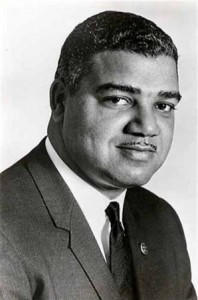
An educator, humanitarian, author and civil rights leader, Whitney M. Young, Jr. dedicated his life to the full participation of African Americans in the nation’s economic and political systems. For more than two decades, he led the National Urban League in its effort to improve the economic status of African Americans. Young accomplished this by working within the economic and political systems to achieve equal opportunities.
Young firmly believed that full participation of African Americans in the business community would ultimately strengthen the fiber of our society. His vision transcended the boundaries of our nation, as he foresaw the need to strengthen the critical link between the United States and the global economy. Young received his undergraduate degree from Kentucky State College. After a brief stint in the U.S. Army, he continued his formal education at the University of Minnesota, where he received a Master of Arts degree in Social Work. After obtaining this degree, Young accepted his first position with the National Urban League as the Director of Industrial Relations and Vocational Guidance in St. Paul, Minnesota. In 1953, he took a brief hiatus from the Urban League to become the Dean of Atlanta University’s Graduate School of Social Work. Young served in that position until he was appointed as Executive Director of the National Urban League in 1961.
On March 11, 1971, Whitney M. Young, Jr. died while attending the African American Dialogue (a Conference held to strengthen the relationship between people of African descent throughout the Diaspora) in Lagos, Nigeria. Through the Conference, the African American community at The Wharton School acknowledges and memorializes the contributions and ideals of Whitney M. Young, Jr.
Meet the Conference Founders
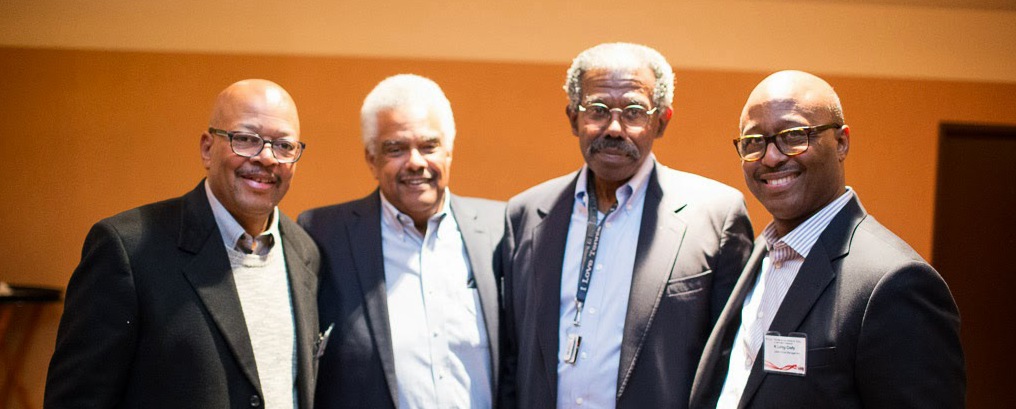
From Left to Right: Milton Irvin, Merritt Brown, Ben Roland Jr., Leroy Cody
The late 1960’s and early 1970’s were a period of turmoil in the United States.Martin Luther King and Robert Kennedy were assassinated, the Vietnam War was winding down, U.S. median household income was $9,697, and the DJIA was around 1,000.
And thanks to the many brave men and women who marched, demonstrated and died in the civil rights movement, the first wave of African Americans entered Ivy League business schools.
The Wharton Graduate School was no exception. Starting in the early 1970’s, increased numbers of African Americans were admitted to Wharton’s MBA program. These pioneers came from varied backgrounds and undergraduate schools, many from Howard University, which for a time was a top feeder school for Wharton.
Black matriculates in the Wharton Graduate class of 1974 were no exception. The 35 African American members of that mostly male class came from several historically black colleges and universities and other mainstream schools. Several were engineers, and others had undergraduate degrees in accounting, math, physical sciences and liberal arts. Many were the first in their families to earn a college degree and entered Wharton Graduate with some trepidation. At that time, there were almost no black role models for these students, no family members or friends with whom they could ask for guidance in navigating the competitive Wharton Business School. There was one black professor at Wharton during that time, Dr. Bernard Anderson, who mentored African American students in entering classes.
The four African American founders of the Whitney M.Young Conference (WMY), Merritt C. Brown, Ben Roland Jr., H. Leroy Cody, and Milton Irvin were all members of the Wharton Graduate class of 1974. It is safe to say these four young men were (1) determined to graduate from Wharton, and (2) leave the school better than they found it. To that end, they developed a concept, the Whitney M. Young, Jr. Memorial Lecture Series, to introduce black culture and business perspectives at Wharton and the larger Penn campus. They wanted to show that African Americans could contribute to Wharton from a business perspective.
As originally conceived, The Whitney M. Young, Jr. Memorial Lecture Series was to be an ongoing program,where distinguished African American businessmen and women were invited to speak and lecture periodically at Wharton. The WMY Conference founders decided to start the series with a one-day conference in the Fall of 1973,with a budget of less than $5,000, donated by Pepsi-Cola, Exxon and Goldman Sachs.
Planning for the kickoff WMY Conference took place in a very informal and ad hoc fashion, we met often in Vance Hall (between or after classes) to brainstorm ideas, develop content, plan logistics, marketing strategy and speaker lists,because in those days there was no email, social media, cell phones or even fax machines. Over the summer of 1973, Ben Roland and Merritt Brown typed (there were no computers) and mailed invitations to selected speakers, which included Thomas Murphy, Vice-Chairman GM, John Bunting, President of First Pennsylvania Bank, and C. Dolores Tucker, Secretary of State for the State of Pennsylvania, who was our keynote speaker. The program consisted of two speakers in the morning, followed by a catered Penn Faculty Club lunch, and another two speakers in the afternoon. There were approximately 75 people in attendance at the conference. Ben Roland and Merritt Brown handled much of the scheduling and logistics, even shuttling speakers to and from the airport, while Leroy Cody and Milton Irvin handled master of ceremony responsibilities, but the entire first and second year classes of African American students pitched in to help with this project. There were no conference breakout sessions, receptions, awards or post-parties, we were all exhausted and went home immediately after the conference ended.Midterms were coming up and we had to write papers and study for exams.
While the four founders shouldered much of the responsibility for planning and executing the first Whitney M. Conference in 1973, other Wharton classmates and members of the Wharton Black MBA Association, including Lloyd Freeman and Theresa Nash (Class of 1975), and Richard Hackney (Class of 1973), ably assisted us. And it was Lloyd and Theresa’s class that successfully conducted the second Whitney M. Young Conference in 1974, followed by Larry Bailey’s class in 1975. By then the Whitney M. Young Conference was an institution at Wharton, and it has grown to be emblematic of contributions made by African American students at Wharton and in the business world.
From the beginning, the Wharton administration was supportive of the kickoff Whitney M. Young Conference, which was held entirely in amphitheater classrooms and common areas in Vance Hall.
Post-conference, we continued with our plan to invite distinguished black business and community leaders to speak at Wharton, mostly at Penn Faculty Club dinners. Invitees included the president of the North Carolina Mutual Life Insurance Company, William J. Kennedy Jr.,and Hillary Holloway, Vice President and General Counsel, Philadelphia Federal Reserve Bank. Eventually, the continuing lecture series was dropped in favor of an annual conference.
Decades later, the Whitney M. Young Conference is the largest student run event on Penn’s campus, and the founders and planners of the first Whitney M. Young Conference could not be more pleased. Our original dream, to bring a positive black business perspective to the Wharton School has been achieved many times over. Throughout the years the teams of men and women who plan and execute each years’ conference take pride in building on that heritage.
Merritt C. Brown
H. Leroy Cody
Milton Irvin
Ben Roland Jr.